The Establishment of Jazz in Academia
Throughout the decades leading up to the 1960s, jazz established itself as a crucial part of the American music tradition, specifically as a Black art form. Jazz had actively rejected the white homogeneity of music by creating a product that was socially and aesthetically Black.1 The improvisatory and participatory nature of the music linked itself to ideas of artistic liberation, thereby establishing a clear link to political freedom. Musicians such as saxophonist John Coltrane, bandleader Sun Ra, and vocalist Nina Simone all participated in the free-flowing musicality of jazz while simultaneously advocating for freedom in their political and social lives.
Many commercially popular and politically active jazz artists of the time like Miles Davis, Max Roach, Abbey Lincoln and Oscar Peterson utilized the traditions of improvisation and embraced the Black origins of the genre.2 Despite their success, jazz was still denounced by many critics, who claimed that the music was “primitive” and overly political. Established musicologists, university program directors, and teachers lambasted the genre and went to great lengths to keep it out of higher education curricula. However, proponents of jazz took active steps throughout the 1960s to reduce negative perceptions of the genre and instead emphasize its academic value, while continuing to recognize its culturally Black foundations. One of the landmark writings on jazz was the 1963 book Blues People by Amiri Baraka (born LeRoi Jones); this was one of the first books written about jazz that recognized and fully embraced the Black history of the genre. The book chronicles the history of jazz, from work songs and spirituals in the late 1800s, to the revolution of the blues starting in the 1920s, to the popular free jazz and avant-garde scenes in the 1960s. A clear link was being drawn between music, critical thought, Black nationalism, and the Black Aesthetic (a social, ethical, and artistic movement that foregrounded Black people’s interests). Baraka was a major proponent of the concept of New Black Music as a functional way to understand music created by Black culture—in this case, jazz—in order to lead critical dialogue and discussion.3 Baraka was one of the first prominent scholars to document and seriously write about jazz as a complex musical art form, which was not a stance shared by many critics of the time.

Image of the cover of Blues People by Amiri Baraka (LeRoi Jones), 1963.
Efforts to bring jazz into music academia were often put down harshly by critics, academics, and administrators. Many of the criticisms against jazz pitted it against European classical music and regarded the differences between jazz and classical as fundamental issues. The improvisatory nature of jazz soloing was deemed a negative aspect in contrast to the notated and rehearsed melodies and accompaniment of classical music. Jazz artists also often performed in underground venues as opposed to the sleek and established concert halls designed for classical music. Supporters of jazz had to fight hard to have the genre be accepted into modern day academia. This created a strange dichotomy within jazz in the 1960s, as it tried to be accepted within academia and the white pedagogical framework while still retaining its status as a Black cultural product. This forced jazz into a difficult position in which it, and other Black musical genres, must still contend with to this day.
Opposition to Jazz

“All That Writing on All That Jazz” by Paul Henry Lang, a c. 1960 article highly criticizing and scrutinizing jazz as a genre.
Although jazz had been an established genre for decades, it only began being valued and accepted into higher education in the 1960s. During this time period, there was still significant opposition to the formation of jazz ensembles and programs in higher education, as many music scholars believed that such ensembles would be damaging to classical music traditions. Musicologist and music critic Paul Henry Lang wrote an article in c. 1960 arguing that jazz was morally impure and encouraged sexual deviance, therefore causing what he saw as the downfall of “Western” music.4 Lang claims that jazz was a “lower” form of music, but that some examples of musicians, such as trumpeter Louis Armstrong and pianist Duke Ellington, were producing something of value. Lang attributes the success of these specific musicians to elements of classical music “seeping down” into the genre of jazz and allowing some musicians to rise above the “grime” and “blight” of commercial jazz.5 In making this claim, Lang asserts that the success of Black musicians such as Armstrong and Ellington was solely due to the influence of music traditionally associated with whiteness, and that the rest of the jazz genre does not on its own produce anything of value.
“Ordinary jazz sounds all alike with its rhythmic pattern upon which a bland tune is superimposed on which slight improvisations may be extemporized by players who carry in their heads a few harmonic formulas as the basis for rough and ready counterpoint.”
– Paul Henry Lang in “All That Writing on All That Jazz,” disparaging jazz as sounding the same and boring and downplaying the skill and knowledge of jazz musicians.
Lang was an influential figure in American musicology during the time in which he published his derogatory opinions about jazz; he studied musicology in Budapest and Paris in the 1920s before finishing his studies in the United States, where musicology was not yet an established field. He taught at Columbia University during the 1940s, where he educated one of the first generations of American musicologists.6 Lang was one of the founders of the American Musicological Society, and was the chief Music Critic for the New York Herald Tribune from 1954 to 1973, during which time this article was written.7 As a notable scholar of classical music, Lang being such an outspoken critic of jazz demonstrates a deeper distaste for jazz music within the scholarly community at the time. Additionally, his insistence that jazz lacked any artistic value aside from the elements of classical present in the genre indicates his refusal to assign value to Black cultural products without them having been in some way inspired by or taken from European culture. This view characterizes many of the arguments against jazz music in higher education, as it fed into the general idea that jazz did not deserve to be taught in music programs alongside classical music.
“Let us rid the schools of this noisome nonsense and stop its interference with the real goals of education.”
– Herbert P. Henderson, former director of bands at UMD, in a 1964 interview with George Wiskirchen in the magazine Down Beat.8
These views were echoed at the University of Maryland, where jazz was not accepted as an academic discipline by music faculty. In a 1964 article in Down Beat magazine, UMD Director of Bands Herbert P. Henderson was quoted as stating that jazz was only “dance music,” and that it was “inferior ethically to much other music.”9 Henderson further argued that performing jazz music could be “detrimental to proper musical development,” claiming that jazz was too “musically primitive” for students to learn proper musicality and technique.10 He concluded his statement by saying that music directors should not allow jazz bands at universities because they could result in concert bands disappearing altogether, and that they must “rid the schools of this noisome nonsense [emphasis added] and stop its interference with the real goals of education.”11 His scathing views on jazz and his insistence on its lack of place in higher education are indicative of the contemporaneous policies of the UMD School of Music at large. It is clear from his remarks that he did not endorse jazz bands or jazz courses within the program, as he did not see jazz as having any musical value compared to classical music. The potential ramifications of these views were not confined to the University of Maryland, as Henderson’s argument was featured in a national publication. This reveals the influence that instructors like Henderson have even outside of their institutions, and illustrates that the issues present in the UMD School of Music were only one part of a larger cultural debate at the time

Image of Hubert P. Henderson, former band director of UMD from 1955-1965, legacy.com, year unknown.
Views against jazz remained pervasive at UMD even after Henderson’s departure. In 1967, a music education student named Lloyed Weinberg asked the band directors, Acton Ostling and John Wakefield, about starting a jazz band for the university.12 They refused, and further, would not allow a jazz band to use any rehearsal space in the music building. In 1968, Weinberg and some members of the Phi Mu Alpha music fraternity decided to form a jazz band regardless of the department’s disapproval. They were ultimately given a rehearsal space, but they were not allowed to perform in the concert hall used by any of the other ensembles within the School of Music until 1971.13 Despite this, members of the group described the band as having been quite successful within the UMD community, with packed audiences often coming to see their performances.14
The clear disconnect between student and faculty views of jazz on campus illustrates the lack of value that academics placed on jazz despite its popularity with other groups. Students formed the band and supported it after its creation, while faculty members denigrated the genre and attempted to suppress its implementation at UMD. The bias at the School of Music, placing classical above other genres, can be clearly seen in the school’s course catalogues throughout the 1960s. Jazz was not mentioned in any course descriptions at any point in the decade, and there were no university-sponsored jazz ensembles.15 However, there were many references to classical music across all catalogues, with many course descriptions mentioning classical techniques and composers. One clear example of bias towards classical music is the description for MUSC120: History of Music, which refers to the course as “the study of musical styles from their origins in western Europe to their present day manifestations.”16 This phrasing makes it abundantly clear that the only musical history that the music department was interested in teaching was that of western Europe, implying that no other location had any contributions that the School of Music deemed significant to discuss. The course was called “History of Music,” a very general term that when taken literally, should encapsulate all types of music; yet, in this instance, the term “music” is used only to refer to European classical. The way “music” is used provides insight into what the music department considered to be “real” music worth discussing, and what it did not. This description strongly implies that “real” music comes from western Europe, while music from any other culture does not share the same value.
Additionally, all of the course catalogues from the 1960s state that the first goal of the music department was “[…]to help the general student develop sound critical judgement and discriminating taste in the art of music.”17 When combined with the fact that courses equated “music” with “European classical music,” the stated goal of the department illustrates the attitude that classical music is in some way superior to other types of music, and that studying it gives one better “judgement” and “taste.” This view is echoed in the course description for “Music 001: Introduction to Music,” which was a required class for music undergraduates throughout the 1960s.18 The description states that this course studied the “…forms and styles of music, leading to an intelligent appreciation of the art and providing a foundation for more advanced courses in the Department of Music.”19 The reference to developing an “intelligent” appreciation for music, which at this point in the curriculum, was only classical, implies elitist attitudes that point to the contemporaneous culture of the School of Music at the time. There was a clear belief that studying classical music led to one becoming intelligent and cultured, while at the same time, jazz was actively being excluded. Through this, we can see what types of music the faculty viewed as being “intelligent” and thus worth studying, and which ones—like jazz—they did not.
The Dichotomy of Jazz in Academia
Music programs across the country were slowly changing to accommodate jazz throughout the 1960s. Active steps were made to “institutionalize” the genre into the canon of Music Education, particularly in secondary school and college programs. These changes were typically made very slowly because of the opposition that jazz faced from critics and academics. Musicologists, such as Lang, were vocally against its inclusion into the musical canon of the time, and college instructors, such as UMD’s Henderson, used their positions of authority and influence to keep jazz music out of the curriculum in their universities.

Cover of the 1st edition of the Lydian Chromatic Concept of Tonal Organization by George Russell, 1953.
Despite the distaste for jazz present in the scholarly community, there were already academic papers and books written on jazz prior to the 1960s, including one particularly noteworthy book called the Lydian Chromatic Concept of Tonal Organization by George Russell, published in 1953. The work links musical modes (specific sets of musical notes) to chords, with a focus on the importance of the lydian mode in jazz, including examples of the music of artists like Miles Davis and John Coltrane.20 This textbook became significant in jazz education due to its thorough analysis of the musical features present in jazz, and it also contributed to making the study of modes a central component in how jazz is taught, including still today.
The presence of jazz in academia is not relegated to just scholarly papers and published books, but also to its inclusion in higher education curricula. After World War II, many veterans were able to attend college for the first time, in part due to the 1944 G.I. Bill. This bill provided veterans with financial assistance, giving many of them the opportunity to attend college for the first time, something that would have previously been inaccessible for many. The influx of racially diverse groups of veterans into higher education led to greater amounts of diversity within the musical community, as veterans attending college for the first time were able to explore their musical interests and provide their expertise in various genres, including jazz.21 Student-run jazz bands in colleges became much more popular in the ’50s and ’60s, and many of these veterans taught jazz at high schools around the country. The number of jazz ensembles in secondary schools doubled from 5,000 to 10,000 by the end of the 1960s.22 With jazz being introduced to more and more younger students in high schools, jazz in colleges became a common consideration among students, many of whom pushed for colleges to add jazz ensembles and curricula. At the University of Maryland in 1967, the Congress of Racial Equality (CORE) chapter on campus urged UMD to create more inclusive environments for Black students.23 One of the steps that CORE suggested was to add courses related to Black culture to the UMD curriculum, such as a jazz studies course.24

The Congress of Racial Equality’s (unrelated to the national organization of the same name) objectives to help create more inclusivity and unity for Black students at UMD. Greenberg, “CORE Sets Objectives for MU Negro Students,” Greenburg, The Diamondback, October 12, 1967.


Program pages from the Quinnipiac Intercollegiate Jazz Festival in 1968, an annual festival held that had many large universities attending with their jazz bands playing.
Although UMD did not establish a jazz program during the ’60s, some other schools across the country did begin to form their own programs, albeit rather slowly and with difficulty. The first universities to have proper jazz programs were the University of North Texas and the Berklee College of Music. The University of North Texas was the first college to have a jazz studies major, with the first graduate in 1947. Still, the program faced significant internal opposition into the 1960s about the inclusion of jazz studies.25 In contrast, Berklee’s jazz program began with the school’s opening, and as such, jazz was immediately a core part of the curriculum. When Berklee began issuing degrees in the 1960s, the college also expanded its jazz programs with the vision of John LaPorta.26 Recommended by LaPorta, Jack Peterson was employed by Berklee and established the first college guitar program. Another Berklee faculty member, Phil Wilson, created jazz, funk, and rock ensembles for the school. Other schools such as The Eastman School of Music and the Jacobs School of Music at the University of Indiana, Bloomington followed suit with their own jazz programs. These schools who truly added jazz to their curriculums for the genre’s own artistic merit were in the minority. Many schools added the bare minimum in the ’60s, and only added jazz for better public perception, to get more students, or as tokenism of diversity.27 Some schools, UMD included, did not even do the bare minimum until later decades.
Jazz occupied a unique position in academia during the 1960s. On one hand, there was a push for jazz curriculum to be included in music schools across the country, which typically prioritized classical music and the white European pedagogy traditionally associated with it. On the other hand, jazz is an inherently Black art form, created by Black people and often describing the Black experience in America. These two concepts were at complete odds with each other during the 1960s. Against backdrop of the Civil Rights Movement, many Black artists attempted to emphasize the social context of their music, while white artists denigrated the genre. The popular emerging subgenres of jazz at the time, avant-garde and free jazz, embraced their Black heritage through the music and album art in order to emphasize how art cannot be separated from its context. Author Amiri Baraka connected jazz music to the concept of the Black Aesthetic, which was a significant social movement throughout the 1960s that attempted to promote African American art and culture.28 The majority of this art focused on the Black experience and struggles in the U.S., and was highly influenced by traditional African art and music. Most importantly, Black Aestheticism strived to maintain the influence of Black culture in Black art, keeping away from white pedagogy of contemporaneous music academia. The avant-garde and free jazz scenes heavily embraced this philosophy, both in the music and accompanying album art seen in albums such as Bitches Brew by Miles Davis, Out for Lunch by Eric Dolphy or Karma by Pharaoh Sander.
“It’s the same socially, musically, politically, and in any department of our lives”
– John Coltrane in an interview with Frank Kofsky about if Coltrane’s music is solely about race.29

Cover of Bitches Brew by Miles Davis, whose album art shows the influences of African diaspora in jazz, 1970.

Cover of Karma by Pharoah Sanders, whose album cover reflects the presence of spirtuality and religion in jazz at the time, 1964.
Despite this, critics of the avant-garde movement criticized the heavy reliance on the Black Aesthetic in jazz musician’s work, and pushed for a “raceless” music scene. These criticisms were harsh and often logically inconsistent, as they argued that the best jazz must reach beyond the social and cultural context in order to become true art.30 Many white critics in academia felt threatened by the free jazz movement, disliking the fact that jazz musicians refused to separate Black culture from free jazz, which they considered to be against white people.31 Some jazz musicians, notably saxophonist and composer John Coltrane, pushed against these claims. Coltrane challenged the assumptions that his—and other jazz musicians’—music is not solely about race and politics, but rather could also be about anything else, such as religion or mysticism. Coltrane did not say that the music has nothing to do with race; rather, he describes how it can also have other meanings.32
The fight for jazz to be accepted into academia did not end in the 1960s, but rather continued into the ‘70s and ‘80s. These movements were often intertwined alongside African-American studies becoming accepted into academia. For example, at UMD in 1967, CORE fought for both jazz studies and African-American studies to be added to University curriculum.33 African-American Studies (named Afro-American Studies Program at the time) was first added to UMD’s course offerings in 1972, specifically referencing courses in Black music, which would likely include jazz.34 Jazz was finally officially accepted as an ensemble by the School of Music in 1973. Jazz Dance was also added in 1973 as a program in the School of Dance.35 By 1974, a Jazz History course, MUSC436: Jazz Then and Now, was added to the School of Music; the course taught the history of jazz from the very beginning of the century, and continues to be run with the same title and course number to this day.36

Description of MUSC436 – Jazz: Then and Now from UMD’s Course Catalogue from 1974.
The name, course number, and even description has stayed exactly the same for decades!

Screenshot from Testudo Schedule of Classes of the course MUSC436 – Jazz: Then and Now, University of Maryland, 2025.
Jazz and Beyond
Although jazz has become an accepted discipline in academia over the last few decades, the same types of criticisms that caused it to be excluded from higher education still persist in other genres today. Many Black genres like hip-hop, rock, and electronic music are sometimes taught in college curricula, but these courses are often not required and only delve into introductory history. Instead of outright denying Black music any space in music academia, it is often relegated to tokenism to gain more funding without meaningfully incorporating these topics into the curriculum. This funding is then usually funneled into traditionally white, classical European music and its theory.37 This process allows institutions to profit from Black art forms without placing any real value on them or respecting their cultural origins. This also means that those who are interested in studying Black forms of music have to learn about them through white European pedagogical frameworks, as music academia is typically structured around Western classical music.
This sidelining of Black voices in music academia often stems from a desire for perceived objectivity, a value influenced by Western classical music. This has led to a push for “colorblindness” by focusing on what is considered to be the music itself, separated from culture. The problem with this mindset is that music, including Black art forms such as jazz and hip-hop, does not live in a vacuum.38 Historically, the push for “colorblindness” was much more blatant when considered in connection to racial issues. Jazz critics during the 60s–70s often contradicted each other, simultaneously arguing that Black jazz musicians were “anti-white” and were “black supremacists,” while denying that jazz had any connections to Black social movements.39 As critics slowly began to accept these connections to Black social movements, they shifted back to Romantic era arguments that music should be judged separately from the society in which it originates.40 This mindset continues into the modern day, as some scholars often push for objectivity in an attempt to focus on the music itself, regardless of the fact that music cannot exist by itself.41
Despite the push by critics for a “raceless” music scene, jazz was and continues to be taught under a white pedagogy. Students take music theory classes based on a Western understanding of music, which often excludes other lenses in which music theory can be understood.42 It is often required to learn about western music theory in order to learn or speak about Black music academically. Academia often makes use of “colorblind” terminology too such as “music theory” and “aural skills” which seem universal on the outside but instead rely heavily on notation standardized by Western classical art music.43
Hip-hop in academia is similar in this instance to jazz, as Black voices are commonly silenced or have their ideas discounted in hip-hop discussions. Other minority groups (such Black women and queer folks) at the intersection of discriminatory practices are often even more relegated to the sidelines in discussions of hip-hop.44 As a result, academic discourse of hip-hop is often lacking Black voices, with many programs not having many, if any, Black faculty. Because of this, the “colorblind” pedagogy in which academia operates is generally not compatible with hip-hop, as it attempts to ignore context that is vital to the traditions of the genre.
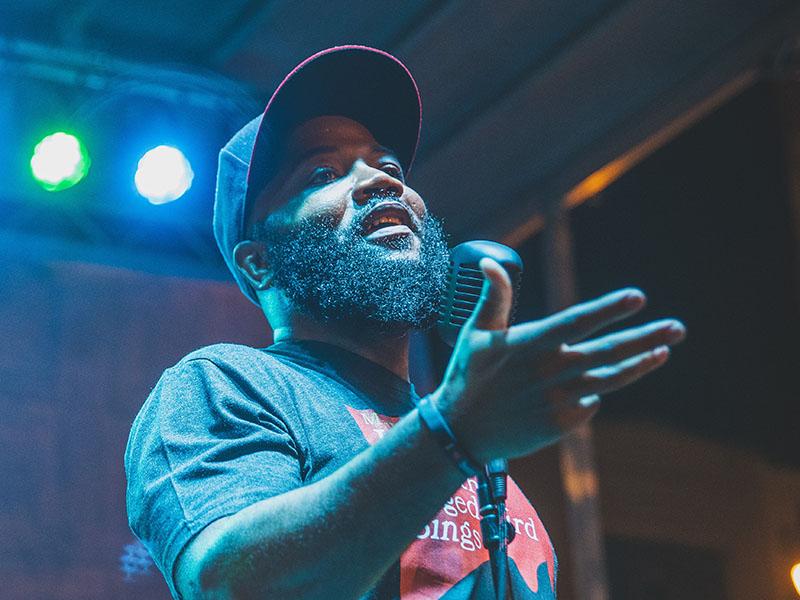
Image of Dr. A.D. Carson, Professor of Hip-Hop at UVA who made a rap mixtape for his Ph.D. dissertation, showing progress is being made for hip-hop’s legitimacy in academia, University of Virginia, year unknown.
Electronic music has faced similar, but different, issues when being considered for inclusion in academia and curricula. Electronic music is often ignored by much of academia; an example of this is the case of turntables and DJing. In 2016, both were added to England’s GCSE music assessments (exams taken by 16 year olds on many subjects to gauge competency), but very rarely do schools use this addition.45 In America, DJing has slightly more use in academia, with a few schools offering classes teaching how to DJ, but it took until 2015 for the first DJing degree to be offered.46 Similar to jazz in the 60s, even when taught, the contributions of Black electronic artists are often ignored in place of white artists. This is especially true in how Black electronic music is often discounted as “just” popular music, or is only recognized when it expresses similar sounds to that of white musicians. For example, repetition in classical music is not very common, and often frowned upon by academia especially if done throughout a composition. In contrast, repetition is a common feature in many Black genres of music because they often contain participatory elements like dancing and jamming. Because of this, music critics often disparage these genres, as there is a somewhat pervasive belief that participatory music with a lot of repetition is less valuable in academia compared to more presentational styles of music.47 While Jazz recordings in the 50s allowed jazz to become a more presentational genre, EDM and other dance genres like disco are still considered to be “blank repetition” without purpose.48 These arguments are very similar to how jazz music was treated by the scholarly community prior to the 60s, as the genre was often considered to be baseless, repetitive, dance music with no substance. Rather than praising the genre for the context in which the music is developed and performed, it is criticized for not following the aesthetics of the academic canon.
Jazz in the 1960s struggled to be accepted into academia while continuing to retain its culturally Black background. Although the genre now plays a large role in music academia, the struggles that it faced in the beginning are still very much relevant today, as other genres such as hip-hop and EDM are currently facing similar criticisms and opposition. It is crucial to remember that the framework in which we teach music genres in academia affects the music, culture, and perception of these genres. Jazz has historically been ignored in place of the Western, classical canon, and what is taught in academia signifies what is important to our culture. As such, there must continue to be discussion and discourse so jazz and other genres with primarily Black contributions are taught to the same standards and degree as classical and other European genres, and not relegated to tokenism to serve the needs of a white framework.
Bibliography
Archival Sources
“Aaron Copland Conducts at Ritchie,” 99. In Terrapin, edited by Ken Firestone. Vol. 66. Undergraduate Student Body of the University of Maryland, 1967. Yearbooks. Digital Collections, University of Maryland Libraries.
“Alpha Omicron Pi,” 36, 50, 59, 350. In Terrapin. Co-edited by Janice Montgomery and John F. Rogers. Vol. 61. Undergraduate Student Body of the University of Maryland, 1962. Yearbooks. Digital Collections, University of Maryland Libraries.
“Baptist Group Presents Jazz Theology At Tuesday Evening Joint Discussion.” The Diamondback. February 4, 1960. Digital Collections, University of Maryland Libraries. https://digital.lib.umd.edu/student-newspapers-old/id/4964c936-24b1-41b5-94d9-5c6929ebe775?relpath=pcdm&query=jazz.
Baraka, Amiri (Leroi Jones). Blues People. William Morrow, 1963. Series 1: Books, 1942–1990. Allen Ahearn Print Collection on Jazz and Blues. Special Collections in Performing Arts, Michelle Smith Performing Arts Library, University of Maryland Libraries.
“Boyd to Read Prayers as Byrd Accompanies.” The Diamondback. November 21, 1966. Digital Collections, University of Maryland Libraries. https://digital.lib.umd.edu/student-newspapers-old/id/788df380-e644-48a6-8435-3d80b042a5ed?relpath=pcdm&query=jazz.
“Byrd Featured at SU Tonight.” The Diamondback. April 7, 1965. Student Newspapers. Digital Collections, University of Maryland Libraries. https://digital.lib.umd.edu/student-newspapers-old/id/7106e7e3-6191-48eb-88f9-e8682ea590fd?relpath=pcdm&query=jazz
“Cambridge,” 427. In Terrapin, edited by Susie (Kaminski) Clark. Vol. 68. Student Government Association of the University of Maryland, 1969. Yearbooks. Digital Collections, University of Maryland Libraries.
“Chapel Choir,” 189. In Terrapin. Co-edited by Pamela Clayton and Sandra Goody. Vol. 60. Undergraduate Student Body of the University of Maryland, 1961. Yearbooks. Digital Collections, University of Maryland Libraries.
“Charlie Byrd Talks, Plays for Sorority.” The Diamondback. March 12, 1965. Student Newspapers. Digital Collections, University of Maryland Libraries. https://digital.lib.umd.edu/student-newspapers-old/id/a07364ef-0eaf-4db7-bb16-bb85e962c15c?relpath=pcdm&query=jazz
Cohen, Robert. “The Westernization of Ivan.” The Diamondback. January 6, 1966. Student Newspapers. Digital Collections, University of Maryland Libraries. https://digital.lib.umd.edu/student-newspapers-old/id/1f7f8c8e-4a57-4c2d-8902-183bf5b3f820?relpath=pcdm&query=jazz
“Cultural Committee,” 244, 152, 171. In Terrapin, edited by Barbara Berger. Vol. 63. Undergraduate Student Body of the University of Maryland, 1964. Yearbooks. Digital Collections, University of Maryland Libraries.
“Cultural Committee,” 152. In Terrapin, co-edited by Emory Kristof and Carol Gebert. Vol. 62. Undergraduate Student Body of the University of Maryland, 1963. Yearbooks. Digital Collections, University of Maryland Libraries.
“Delta Sigma Pi,” 367–369, 384. In Terrapin, edited by Barbara Berger. Vol. 63. Undergraduate Student Body of the University of Maryland, 1964. Yearbooks. Digital Collections, University of Maryland Libraries.
“Diverse Forces Prod Our Mind,” 26–27. In Terrapin, edited by William Ellery Clark. Vol. 65. Student Government Association of the University of Maryland, 1966. Yearbooks. Digital Collections, University of Maryland Libraries.
“Ella Fitzgerald Caps Weekend.” The Diamondback. May 3, 1965. Digital Collections, University of Maryland Libraries. https://digital.lib.umd.edu/student-newspapers-old/id/3960c3a6-f2d9-48ab-b63b-dd151526ab18?relpath=pcdm&query=jazz.
“Ever Towards Greatness…,” 7–8. In Terrapin, edited by William Ellery Clark. Vol. 65. Student Government Association of the University of Maryland, 1966. Yearbooks. Digital Collections, University of Maryland Libraries.
Gray, Williams, and Dossie Terry. “Standard Uniform Popular Songwriters Contract. ” Enrica Music Corp. June 10, 1957. Box 4, Folder: November 23, 24, 25, 1961 Clippings. Series 2: Enrica Records Incorporated, 1957–1981. Teddy McRae Papers. Special Collections in Performing Arts, Michelle Smith Performing Arts Library, University of Maryland Libraries.
Greenberg, Barbara. “CORE Sets Objectives for MU Negro students.” The Diamondback. October 12, 1967. Student Newspapers. Digital Collections, University of Maryland Libraries. https://digital.lib.umd.edu/student-newspapers-old/id/30014404-56f0-445d-9f84-982126a5dc22?relpath=pcdm&query=jazz.
Hentoff, Nat. “Ellington and Band Play Town Hall Jazz Concert.” New York Times. November 23/24/25 [?], 1961. Box 4, Folder: November 23, 24, 25, 1961 Clippings. Series 2: Published Articles and Clippings, 1938–1961. Lilla Belle Pitts Papers. Special Collections in Performing Arts, Michelle Smith Performing Arts Library, University of Maryland Libraries.
“From Olympus to Maryland, Greek Spirit Lives On,” 362. In Terrapin, co-edited by Emory Kristof and Carol Gebert. Vol. 62. Undergraduate Student Body of the University of Maryland, 1963. Yearbooks. Digital Collections, University of Maryland Libraries.
“IFC Ball,” 50. In Terrapin. Co-edited by Janice Montgomery and John F. Rogers. Vol. 61. Undergraduate Student Body of the University of Maryland, 1962. Yearbooks. Digital Collections, University of Maryland Libraries.
“IFC Presents Ella Fitzgerald,” 32–33. In Terrapin. Co-edited by Janice Montgomery and John F. Rogers. Vol. 61. Undergraduate Student Body of the University of Maryland, 1962. Yearbooks. Digital Collections, University of Maryland Libraries.
“The Junior Promenade,” 128. In Terrapin. Co-edited by Pamela Clayton and Sandra Goody. Vol. 60. Undergraduate Student Body of the University of Maryland, 1961. Yearbooks. Digital Collections, University of Maryland Libraries.
Keller, Ann. “Dance: Freedom Through Discipline,” 12, 50. In Terrapin, edited by Ken Firestone. Vol. 66. Undergraduate Student Body of the University of Maryland, 1967. Yearbooks. Digital Collections, University of Maryland Libraries.
Lang, Paul Henry. “All That Writing On All That Jazz.” c. 1960. Box 5, Folder 1: L.B. Pitts: Series II [All That Writing On] All that Jazz-On Paul Henry Lang c. 1960. Series 2: Published Articles and Clippings, 1938–1961. Lilla Belle Pitts Papers. Special Collections in Performing Arts, Michelle Smith Performing Arts Library, University of Maryland Libraries.
LaRoche, Marianna. “Ellison Welcomes New Students.” The Diamondback. September 10, 1969. Student Newspapers. Digital Collections, University of Maryland Libraries. https://digital.lib.umd.edu/result/id/0c8097bf-2cb2-47d1-96c6-4065249039e4?relpath=pcdm&query=1969-09-10.
“McKayle Troupe Slated for Ritchie.” The Diamondback. May 5, 1965. Student Newspapers. Digital Collections, University of Maryland Libraries. https://digital.lib.umd.edu/result/id/4dead899-0554-44f9-9e58-af4e52ff8fdc?relpath=pcm&query=1965-05-05.
Mitchell, John, “Phi Mu Alpha Jazz Band (Origins).” Unprocessed document provided by University Archivist. Special Collections and University Archives, Hornbake Libraries, University of Maryland Libraries.
“National Symphony,” 25. In Terrapin. Edited by C. Stuart Callison. Vol. 59. Undergraduate Student Body of the University of Maryland, 1960. Yearbooks. Digital Collections, University of Maryland Libraries.
“Noted Leader Ray Charles Jazz and Gospel Musician.” The Diamondback. October 28, 1960. Digital Collections, University of Maryland Libraries. https://digital.lib.umd.edu/student-newspapers-old/id/e456e189-070f-465c-b05a-8e441e6d6de1?relpath=pcdm&query=jazz.
“Performing Arts,” 424. In Terrapin, edited by Lisa Taylor. Vol. 67. Student Government Association of the University of Maryland, 1968. Yearbooks. Digital Collections, University of Maryland Libraries.
Quinnipiac Intercollegiate Jazz Festival. Brochure for the 1968 Quinnipiac Intercollegiate Jazz Festival. April 19–20, 1968. Box 30, Folder 7: Quinnipiac College IV. 4.6 [1968–1971] Programs. Series 6: Notebooks, 1937–1979. Asher G. Zlotnik Papers. Special Collections in Performing Arts, Michelle Smith Performing Arts Library, University of Maryland Libraries.
“Senior Prom,” 126. In Terrapin, co-edited by Emory Kristof and Carol Gebert. Vol. 62. Undergraduate Student Body of the University of Maryland, 1963. Yearbooks. Digital Collections, University of Maryland Libraries.
“S.G.A Cultural Committee,” 56–59. In Terrapin. Co-edited by Janice Montgomery and John F. Rogers. Vol. 61. Undergraduate Student Body of the University of Maryland, 1962. Yearbooks. Digital Collections, University of Maryland Libraries.
“St. Louis Blues, Crazy Rhythm,” 50. In Terrapin, edited by Lisa Taylor. Vol. 67. Student Government Association of the University of Maryland, 1968. Yearbooks. Digital Collections, University of Maryland Libraries.
“Symphony Orchestra,” 182. In Terrapin, co-edited by Donna Skoglund and Doran Jay Levy. Vol. 64. Undergraduate Student Body of the University of Maryland, 1965. Yearbooks. Digital Collections, University of Maryland Libraries.
“Symphony Band,” 548. In Terrapin, edited by Susie (Kaminski) Clark. Vol. 68. Student Government Association of the University of Maryland, 1969. Yearbooks. Digital Collections, University of Maryland Libraries.
Terry, Dossie, and Art Shelton. Soul Food. Doart Music Publishing Co. January 1968. Box 1, Folder 11: Client Scores and Legal Documents. Series 7.2: Sheet Music, 1935–1984 and Undated. Teddy McRae Papers. Special Collections in Performing Arts, Michelle Smith Performing Arts Library, University of Maryland Libraries.
Tirro, Frank. “The Silent Theme Tradition in Jazz.” The Musical Quarterly 53, no. 3 (July, 1967): 313. Box 31, Folder 7. Series 6: Notebooks, 1937–1979. Asher G. Zlotnik Papers. Special Collections in Performing Arts, Michelle Smith Performing Arts Library, University of Maryland Libraries.
The University of Maryland, “Combined catalog. Vol. 1, College Park, University of Maryland.” 1960. Course Catalogues. Digital Collections, University of Maryland Libraries. https://archive.org/details/combinedcatalog1961univ.
The University of Maryland, “Combined catalog. Vol. 1, College Park, University of Maryland.” 1962. Course Catalogues. Digital Collections, University of Maryland Libraries. https://archive.org/details/combinedcatalog1962univ.
The University of Maryland, “Combined catalog. Vol. 1, College Park, University of Maryland.” 1964. Course Catalogues. Digital Collections, University of Maryland Libraries. https://archive.org/details/combinedcatalog1962univ/page/616/mode/2up?q=1964.
The University of Maryland, “Combined catalog. Vol. 1, College Park, University of Maryland.” 1966. Course Catalogues. Digital Collections, University of Maryland Libraries. https://archive.org/details/combinedcatalog1966univ.
The University of Maryland, “Combined catalog. Vol. 1, College Park, University of Maryland.” 1969. Course Catalogues. Digital Collections, University of Maryland Libraries. https://archive.org/details/combinedcatalog1968univ.
Wilson, John S. “Ellington’s Band in Program Here.” New York Times. November 23, 1961. Box 4, Folder: November 23, 24, 25, 1961 Clippings. Series 2: Published Articles and Clippings, 1938–1961. Lilla Belle Pitts Papers. Special Collections in Performing Arts, Michelle Smith Performing Arts Library, University of Maryland Libraries.
Wiskirchen, George “Jazz on Campus,” Down Beat 31, no. 6 (Feb. 27, 1964): 39.
“WMUC–The Campus Sound,” 168. In Terrapin, co-edited by Emory Kristof and Carol Gebert. Vol. 62. Undergraduate Student Body of the University of Maryland, 1963. Yearbooks. Digital Collections, University of Maryland Libraries.
“Women’s Chorus,” 208. In Terrapin, co-edited by Emory Kristof and Carol Gebert. Vol. 62. Undergraduate Student Body of the University of Maryland, 1963. Yearbooks. Digital Collections, University of Maryland Libraries.
Scholarly Sources
Baskerville, John D. “Free Jazz: A Reflection of Black Power Ideology.” Journal of Black Studies 24, no. 4 (1994): 484–97.
Feldstein, Ruth. “‘I Don’t Trust You Anymore’: Nina Simone, Culture, and Black Activism in the 1960s.” The Journal of American History 91, no. 4 (2005): 1349–79. https://doi.org/10.2307/3660176.
Garcia, Luis-Manuel. “On and On: Repetition as Process and Pleasure in Electronic Dance Music.” Music Theory Online 11, no. 4 (October 2005): 1–14.
Haworth, Christopher and Jake Williams. “Editorial: Radical Education in Electronic Music, Past and Present.” Organised Sound: An International Journal of Music Technology 29, no. 2 (August 2024): 105–110. doi.org/10.1017/S1355771824000153.
Kajikawa, Loren. “Leaders of the New School? Music Departments, Hip-Hop, and the Challenge of Significant Difference.” Twentieth-Century Music 18, no. 1 (February 2021): 45–64. doi.org/10.1017/S1478572220000262.
Kajikawa, Loren. “What Does Race Have to Do with Music Libraries and the Performing Arts?” Quarterly Journal of the Music Library Association 78, no. 3 (March 2022): 314–18.
McMichael, Robert K. “‘We Insist-Freedom Now!’: Black Moral Authority, Jazz, and the Changeable Shape of Whiteness.” American Music 16, no. 4 (1998): 375–416. https://doi.org/10.2307/3052287.
Robinson, Jason. “The Challenge of the Changing Same: The Jazz Avant-Garde of the 1960s, the Black Aesthetic and the Black Arts Movement” Critical Studies in Improvisation/Études Critiques en Improvisation 1, no. 2 (2005): 20–37.
Ross, Megan. “Continuing the Quest for Legitimacy: The Institutionalization of Hip-Hop DJing Education.” Master’s thesis, University of North Carolina, Chapel Hill, 2015. ProQuest Dissertations & Theses.
Snyder, Randy Lee. “College Jazz Education during the 1960s: Its Development and Acceptance.” DMA diss., University of Houston, 1999. ProQuest Dissertations & Theses.
Additional Sources
“A. D. Carson.” University of Virginia. Accessed November 14, 2025. https://music.virginia.edu/people/ad-carson.
Arango, Mateo, Lauren Cain, Wanda Hernández, Kristy Li Puma, Benjamin Shaw, Sarah Wampler, and Alan Wierdak. “Claiming Their Space: Black Student Activism at the University of Maryland.” Digital Exhibit. Spring 2020. Accessed November 14, 2025. https://bsuatumd.artinterp.org/omeka/exhibition-about.
Brook, Claire. “Tribute to Paul Henry Lang (1901–91),” Acta Musicologica 64, (Jul.–Dec., 1992): xi-xii.
Coltrane, John. “A Love Supreme, Pt. 1 – Acknowledgement.” Track 1 on A Love Supreme. Impulse!, 1964.
Kofsky, Frank. Black Nationalism and the Revolution in Music. Pathfinder Press, 1970.
Mingus, Charles. “Track A- Solo Dancer.” Track 1 on The Black Saint and the Sinner Lady. Impulse!, 1963.
“Paul Henry Lang.” Columbia University Libraries. Accessed October 10, 2025. https://exhibitions.library.columbia.edu/exhibits/show/music-centennial/historical-musicology.
“Station History.” In Saving College Radio: WMUC Past, Present, and Future. University of Maryland Libraries, Virtual Exhibitions. Accessed October 30, 2025. https://exhibitions.lib.umd.edu/wmuc/before-wmuc.