In the United States, the 1960s were a decade defined by a growing demand for change. Across the country, citizens protested against the Vietnam War, the military draft, and the Cold War. Many Americans were unhappy not only with the war but also with the government and leaders in power; people were frustrated at the lack of transparency about the war, disillusioned with the idea that governments could protect people, and frightened by the amount of destruction. Their frustration led to widespread protests calling for peace, fairness, and change, creating a rise of a powerful youth counterculture that embraced an anti-war perspective and rejected traditional values such as unquestioned authority, capitalism, and materialism. Music became a central voice of the movement, offering young people a way to express themselves to protest war, challenge authority, and promote ideals of peace, love, and freedom. They sought alternative ways of living, thinking, and expressing themselves. Folk music, in particular, became a major form of expression for the anti-war movement.
Conflict of Controversy: The Vietnam War
The Vietnam War was highly controversial, sparking widespread criticism of the government and the military draft, gradually causing a shift in public opinion. This tension grew from the lingering fear of communism both within and outside the US in the 1950s, known as the Red Scare. The Red Scare set the tone for political polarization of the 60s, a time when anti-communist sentiment was so high that being accused of communism could destroy a person’s reputation and career.
As the war dragged on and the number of American casualties grew, public trust in the government began to decline. In the mid 1950s, when the US first began to take part in Vietnam’s conflict, most Americans had little idea that their country was involved. Over the following decade, the US involvement in the war steadily increased; however, public interest in the war remained minimal. Even by 1964, when American involvement had expanded enough to become mainstream news, the majority of citizens showed little interest or awareness of the events occurring in Vietnam.1
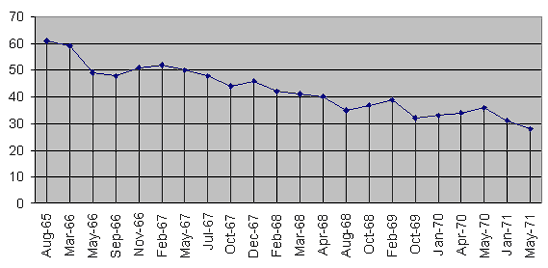
Public opinion on the war especially began to shift after the Tet Offensive, an attack on South Vietnam and the US Although this attack was orchestrated by North Vietnam against South Vietnam and the US, the attack shocked the public as the American people realized they were being lied to by President Johnson and the government, who had claimed that the US was doing well in Vietnam and that communism was fading. This exacerbated public opinion on the war because the people finally got to see first hand that the claims the president and the government were making were false. Effects of the Tet Offensive on the public included a widespread change from support of military mobilization to calls for a reduction in military effort, a decline in the proportion of Americans who believed the US was making progress and a deterioration in approval of President Johnson.2 Another major reason for the shift in attitudes toward the Vietnam War was the 1969 draft under the selective service system; a lottery system in which young men born between 1944 and 1950 were randomly selected to be drafted into the war, often against their will.3These factors led to a growth in anti-war sentiments and a call for action that was mainly led by the youth.

As public sentiment against the Cold War and Vietnam War increased in the 1960s, the growing opposition inspired folk song lyrics and led to a revival of the genre.4 In turn, folk music played a significant role in this anti-war movement. Folk artists were often accused of being communists (or communist sympathizers) by the government and other Americans, which led to the cancellation of shows and repression of the art form as a whole. A prime example of this is Woody Guthrie, one of the original artists of the folk revival, whose working-class and equality-focused lyrics were ironically seen as “un-American.” His song “This Land is Your Land” served as a reminder to the American people that America belongs to everyone, not just the rich or the powerful.5 The lyrics of this song criticize the unfairness in the country at the time; they criticize how some go hungry or are turned away by “Private Property” signs, showing that not everyone truly gets to share the nation’s land. The irony is that, although Guthrie celebrated the idea that America should be equal and welcoming, he was suspected of being a communist and was even investigated by the FBI alongside fellow folk artists and group members Pete Seeger, Millard Lampell, and Lee Hayes.6 The censoring and accusation of these artists further reified the division in American society during the Red Scare.
The folk revival, in the context of the Cold War, was more than just a musical movement; it was a cultural response to push back against the fear and division at the time. Many Americans were being taught to distrust anyone, particularly communists, who had ideas that the government disliked, but folk musicians focused on creating a community of empathy and caring for others. Instead of seeing people of different beliefs as the enemy, the folk movement encouraged understanding and connection. By doing this, folk music challenged the government’s message of fear and extreme nationalism, and instead embraced inclusion and social awareness. A large part of the genre’s rediscovered popularity was due to the view that the system was broken because the American citizens were living in a time of political dishonesty, social inequality, and growing unrest.

The Youth and Anti-War Protests
Central to the anti-war protests regarding the Vietnam War were college-aged students, including those at the University of Maryland, College Park. UMD was the site of numerous protests against the war due to the Students for a Democratic Society (SDS) organization on campus.7 This organization was considered to be “revolutionary” by the United States government as they pushed for major social changes nationwide on college campuses.8 Student organizations like the SDS showcased how the youth were breaking a habit of conformity to the government and pushing away from the post-WWII rise in conservative values and American ideals; many times, the organization was labeled as communist because they protested against the government. At UMD, the SDS became a leading voice for student activism, organizing rallies, teach-ins, and demonstrations that called for an end to the war and greater student involvement.
In March, 1969, the UMD SDS published a report named “The University of Maryland and The Military-Industrial Complex,” to expose to the campus community how the university’s resources and investments were “aiding and abetting institutions of racism, imperialism, and military aggression.”9 According to this report, UMD was conducting “several millions of dollars worth of military research, including work for the CIA, the Institute for Defense Analysis (IDA), and the Army Chemical Biological Warfare research (CBW).”10 The SDS also brought to light the fact that UMD owned seven million dollars in stock in 98 different corporations; one of those corporations was the Dow Chemical Company, which made napalm, a highly toxic and controversial chemical used in the Vietnam War.

One of the major demonstrations the UMD SDS organized was against the Reserve Officers’ Training Corps (ROTC), where they stopped the Air Force ROTC from registering students and destroyed their papers. The SDS did this because they believed that ROTC “play[ed] a pivotal role in the imperialist system.”11 Their presence at UMD highlighted how young people across the country were beginning to see themselves as a force for change, willing to face punishment and criticism to stand up for their beliefs.
A look at key locations where administrators, community leaders, and students at the University of Maryland protested, organized, and responded to the anti-Vietnam War movement in the 1960s.
In addition to the SDS, the Student Government Association (SGA) also advocated for change. According to a 1969 Diamondback article, the SGA legislature voted to “end all search and missions, withdrawal to cities of the US and the phased withdrawal of American fighting men.”12 This demonstrates that opposition to the war was shared by student leaders, not just radical groups such as the SDS. The unification of the student body against the war can be seen in a Diamondback photospread captioned “Mall alive despite University warning against use.”13 The images of the photo supplement capture students gathered at McKeldin Mall in defiance of University orders. The photos show how united students were in their opposition to the war and how determined they were to keep protesting despite administration warnings.

More Student Involvement
The Vietnam War not only unified the UMD student body but also divided it, creating tensions between those who supported the anti-war movement and those who backed the government and military. On September 24, 1969, the SDS held a rally and a teach-in.14 After 45 minutes, the rally was interrupted by two to three students who pummeled the SDS officers and ripped down their Viet Cong flag. The rally continued until the fighting commenced once more. This time, 15 to 20 students were involved. 15 These fights showcased just how divided UMD had become over the Vietnam War. It also demonstrated how some students felt strongly about what they believed was patriotic and loyal to the United States.
This view of “vertical imagined community” is also reflected in many militaristic perspectives on the war. The viewpoint emphasized values such as military strength, discipline, and a hierarchical system of authority essential for national prosperity and safety. While folk music is often associated with countercultural themes and anti-war protests, it was also utilized to support pro-military and nationalist ideas. For example, the folk-style ballad “Ballad of the Green Berets” was written and performed by Staff Sgt. Barry Sadler, a Green Beret and a member of a highly specialized “A-Team.” The song celebrates the fearlessness and skill of the US Army Special Forces, with lines such as “Fighting soldiers from the sky/Fearless men who jump and die” portraying military service as an honorable national duty, aligning with a vertical, patriotic, and pro-establishment perspective. The song is infused with a steady, rhythmic tempo, provided by percussion reminiscent of a military march. Sadler’s vocals are strong and clear, with a limited vocal range, ensuring the lyrics are easily understood and highly memorable, which are basic elements of the folk genre. 16

Music as a Protest Medium
Folk music also became a powerful way for those across the nation and UMD students to express their opposition to the Vietnam War. Artists like Pete Seeger, Joan Baez, and Bob Dylan inspired students to challenge authority and promote peace through their music. At UMD, this influence was especially clear during events such as the Moratorium to End the War in Vietnam, where Pete Seeger performed and used his songs to unite people.
The Moratorium to End the War in Vietnam

The Moratorium on November 15, 1969, was the largest protest of the 1960s, featuring a massive march in Washington, D.C., along Pennsylvania Avenue towards the White House. At the protest, many artists performed songs as part of the demonstrations. Among these artists was Pete Seeger, who performed some of his songs as well as songs by other artists.17At this demonstration, he performed his song “Bring Them Home (If You Love Your Uncle Sam)” alongside Frederick Douglass Kirkpatrick, a fellow musician and civil rights activist. Later on, he led everyone in a version of John Lennon and Yoko Ono’s “Give Peace a Chance.”18 Both songs were altered lyrically to fit the recent events of the Vietnam War.
The lyrics in “Bring Them Home (If You Love Your Uncle Sam)” focused on calling for the removal of troops in Vietnam with lines like “it’ll make our generals sad, I know/ bring them home, bring them home,” to show the desire to bring the troops home regardless of what the generals in the armed forces thought.19 Another set of lines in the song that were changed at the moratorium was “show the world what must be done; bring them home, bring them home,” calling out to the government and Nixon to bring the troops home and show the world that the US was not supposed to be involved in the war.20 The words “bring them home” are repeated throughout the song, and serve to continue reminding the listener and performer that above all else the soldiers need to be brought home from Vietnam.
Seeger then proceeded to get the crowd to sing along to the chorus of “Give Peace A Chance” which repeats, “All we’re saying is give peace a chance.”21 Seeger omitted some lyrics from the original song such as, “Everybody’s talking about/Bagism, shagism, dragism, madism, ragism, tagism/his-ism, that-ism, ism ism ism,” and, “Everybody’s talking about/Revolution, evolution, masturbation, flagellation, regulation/Integrations, mediations, United Nations, congratulations.”22 By leaving out these verses, Seeger removed the parts of the song that mentioned famous people, jokes, and wordplay. In Lennon and Ono’s original version, the lyrics showed the confusing world of the 1960s, filled with different ideas and movements. In the context of the protest, Seeger perhaps omitted these lyrics to focus on its central message of peace. By focusing only on the chorus, he made it easier for the crowd to join in and feel united. The change in lyrics also altered the song’s purpose; the song shifted from being a multi-layered political and social commentary to a powerful and simple song about peace. During his performance, Seeger also interspersed call-outs to President Nixon, Vice President Agnew, and the Pentagon, such as “Are you listening, Nixon?” while the crowd continued to sing.23
Seeger’s performance of these songs highlights how songs, especially folk music, can be used as powerful protest tools. The music that a person listens to can act as a representation of themselves, their beliefs, or their habits. During adolescence, the music that people listen to can become part of their identity and persist throughout life because adolescence is when behaviors, interests, and values are formed.24 Folk music during the 1960s focused on pushing for societal changes on subjects like the Vietnam War. The youth who protested the Vietnam War regularly on UMD’s campus formed a habit of protesting the government regarding Vietnam, and listening to folk music during the 1960s was a representation of that habit that was formed.25
Playlist of pro- and anti-war songs related to the Vietnam War.
The Coldest War with the Coolest Sound
Folk music in the 1960s was a raw and powerful tool for protest. As the decade ended, the genre experienced mainstream commercialization. Intentionally simple melodies changed to more complex compositions, and the subject matter shifted from social activism and political protests to topics such as love and personal growth that were more palatable to larger, mainstream audiences. Popular folk artists like Glenn Yarbrough and the folk-pop group The Serendipity Singers, featured in the 1969Terrapin, demonstrate this transformation from protest and clearly political topics to less overtly controversial topics to achieve more commercial success.26 The folk revival movement in the 1960s reflected and created a period of musical activism, proving that even the strongest institutions could be questioned and challenged. The decade showed that when youth, music, and activism intersected, calls for change could echo across the country.


Bibliography
Primary Sources
Allen, Ira. “Legislature Endorses Pullback in Vietnam.” The Diamondback. April 11, 1969. Digital Collections. University of Maryland Libraries. https://digital.lib.umd.edu/result/id/158d9fd0-f5f2-443e-bf06-9090325f9b94?relpath=pcdm
Allen, Ira. “Yippies Play Ring-around-the Capitol.” The Diamondback. October 4, 1968. Digital Collections, University of Maryland Libraries. https://digital.lib.umd.edu/result/id/fc20aaee-033f-48c3-8bde-cabdd9fefd2b?relpath=pcdm
Anti-War Slogans from 1960s Counterculture. Box 1, Folder: Vietnam Era Photos. Series 7: Research Materials, 1970–2013, Undated. Hugo Keesing Collection on Music and the Vietnam War. Special Collections in Performing Arts, Michelle Smith Performing Arts Library, University of Maryland Libraries.
“Arrests begin Moratorium.” The Diamondback. November 14, 1969. Digital Collections, University of Maryland Libraries. https://digital.lib.umd.edu/student-newspapers-old/id/28814924-a49c-48a5-a161-fd54ed136a8f?query=Moratorium
Barnes, Bart. “5,000 Gather in Cathedral for Peace.” The Washington Post. November 15, 1969.
Barnes, Carolyn. The Hippie Scene. Scholastic Book Services, 1968. Hugo Keesing Collection on Popular Music and Culture. Special Collections in Performing Arts, Michelle Smith Performing Arts Library, University of Maryland Libraries.
Blackstead, Erick. Woodstock: Music from the Original Soundtrack and More. Cotillion Records. 1970. Series 10: Recordings 1959–2005, Undated. Hugo Keesing Collection on Music and the Vietnam War. Special Collections in Performing Arts, Michelle Smith Performing Arts Library, University, University of Maryland Libraries.
Brewster, Daniel B. Press Release Support for Labor Unions August 16, 1967. Box 1, Folder 10: Press Releases. Series 3: Press Releases and Newsletters, 1958–1968. Daniel B. Brewster Papers. Special Collections and University Archives, Hornbake Library, University of Maryland Libraries.
Brewster, Daniel B. “A letter from… Sen. Daniel B. Brewster.” February 1968. Box 1, Folder 11: Press Releases and Newsletters, 1968. Series 3: Press Releases and Newsletters, 1958–1968. Daniel B. Brewster Papers. Special Collections and University Archives, Hornbake Library, University of Maryland Libraries.
“Campus Bulletin.” The Diamondback. December 18, 1969. Digital Collections, University of Maryland Libraries. https://digital.lib.umd.edu/student-newspapers-old/id/4d784ab7-cde2-4e5a-a4e0-f3f7b188c429?relpath=pcdm&query=Vietnam%20Moratorium
Committee on Internal Security. “Anatomy of a Revolutionary Movement: ‘Students for a democratic society.’” October 6, 1970. Folder: Student Organizations – SDS General Information S11. Student Organizations: UPUB S34 S11. University Publications Collection. Special Collections and University Archives, Hornbake Library, University of Maryland Libraries.
“Drugs,” p. 95. In Terrapin, edited by Ken Firestone. Vol. 66. Undergraduate Student Body of the University of Maryland, 1967. Yearbooks. Digital Collections, University of Maryland Libraries.
Guthrie, Woody. “This Land Is Your Land.” 1940. Later released as Track 1 on American Work Songs: Songs to Grow On. Vol. 3. Recorded April 1944. Folkway Records FC7027, 1951.
“Hippy Vies for Presidency.” The Diamondback. May 5, 1967. Digital Collections, University of Maryland Libraries. https://digital.lib.umd.edu/student-newspapers-old/id/e4e46a84-b78a-46e8-ac1e-98b5bb450fc8?relpath=pcdm&query=hippie
“Homecoming Features Tops.” The Diamondback. October 24, 1969. Digital Collections, University of Maryland Libraries. https://digital.lib.umd.edu/student-newspapers-old/id/3f3221e1-d660-4183-8475-b0f7a99
“Hopkins Head Bars Student Voice in Policy: S.D.S. Posts Five Demands on UM Building.” The Baltimore Sun. May 9, 1969. Folder: Student Organizations – SDS General Information S11. Student Organizations: UPUB S34 S11. University Publications Collection. Special Collections and University Archives, Hornbake Library, University of Maryland Libraries.
Johnson, Haynes. “Middle-Class Youth Has Its Day.” The Washington Post. November 16, 1969.
Jones, Carolyn. “Cross Campus.” The Diamondback. April 11, 1969. Digital Collections, University of Maryland Libraries. https://digital.lib.umd.edu/student-newspapers-old/id/2f455683-8394-4693-8630-b8df5c5df0b5?relpath=pcdm&query=hippie
Keesing, Hugo A. Partial Listings of Songs Related to the Vietnam War. March 21, 1987. Box 1, Folder: Vietnam Discographies, bulk: 1991–1993. Series 7: Research Materials, 1970–2013, Undated. Hugo Keesing Collection on Music and the Vietnam War. Special Collections in Performing Arts, Michelle Smith Performing Arts Library, University of Maryland Libraries.
Lightman, Dave. “Moratorium Gains National Support.” The Diamondback. October 20, 1969. Digital Collections, University of Maryland Libraries. https://digital.lib.umd.edu/student-newspapers-old/id/2f455683-8394-4693-8630-b8df5c5df0b5?relpath=pcdm&query=hippie
“Mall Alive Despite University Warnings Against Use.” The Diamondback. October 20, 1969. Digital Collections, University of Maryland Libraries. https://digital.lib.umd.edu/student-newspapers-old/id/24821ebe-90ed-4bca-a781-11a65e08e2e4?relpath=pcdm&query=1969-10-20
McKerrow, Steve. “Mall Opened to Demonstrators.” The Diamondback. September 10, 1969. Digital Collections, University of Maryland Libraries. https://digital.lib.umd.edu/student-newspapers-old/id/f42a4bfb-f5d6-4cf4-b096-7558319413ec?relpath=pcdm&query=hippie
“Moratorium Activity Begins Here” The Diamondback. November 14, 1969. Digital Collections, University of Maryland Libraries. https://digital.lib.umd.edu/student-newspapers-old/id/28814924-a49c-48a5-a161-fd54ed136a8f?query=Moratorium
Parker. “We Respect Your Academic Freedom to Protest… And Will Furnish an Approved List of Controversial Topics!” Washington Post. 1965. Box 11. Accession 2007-51. Wilson H. Elkins Papers. Special Collections and University Archives, Hornbake Library, University of Maryland Libraries.
“Photographs,” p. 10–50. In Terrapin, edited by Susie (Kaminski) Clark. Vol. 68. Student Government Association of the University of Maryland, 1969. Yearbooks. Digital Collections, University of Maryland Libraries.
“Photography: The Newest Art,” p. 63. In Terrapin, edited by Ken Firestone. Vol. 66. Undergraduate Student Body of the University of Maryland, 1967. Yearbooks. Digital Collections, University of Maryland Libraries.
Plastic Ono Band. “Give Peace A Chance.” Track 6 on Live Peace in Toronto 1969. Recorded June 1, 1969. Apple Records 2C062-90877, 1969.
President’s Office. Memorandum to President John T. Williams, Maryland State College Dr. Albin O. Kuhn, Chancellor of the Baltimore Campus Deans, Directors, Department Heads – All Campuses. October 7, 1969. Box 147, Folder: Oct 7, 1969–Vietnam Moratorium 10/15/69. Series 10: Wilson H. Elkins, 1951–1971. Office of the President, University of Maryland Records. Special Collections and University Archives, Hornbake Library, University of Maryland Libraries.
“R.O.T.C: Looking to the Wild Blue,” p. 192–197. In Terrapin, edited by Ken Firestone. Vol. 66. Undergraduate Student Body of the University of Maryland, 1967. Yearbooks. Digital Collections, University of Maryland Libraries.
Sadler, Barry. “The Ballad of the Green Berets.” Track 1 on Ballad of the Green Berets, Recorded December 18, 1965. RCA Victor LPM-3547, 1966.
Scarpelli, Henry. Bewitched. January 1969. Box 6, Folder 22, Bewitched January 1968. Series 9: Time Capsules, 1938–2013. Hugo Keesing Collection on Popular Music and Culture. Special Collections in Performing Arts, Michelle Smith Performing Arts Library, University of Maryland Libraries.
“S.D.S.,” p. 100–102. In Terrapin, edited by Ken Firestone. Vol. 66. Undergraduate Student Body of the University of Maryland, 1967. Yearbooks. Digital Collections, University of Maryland Libraries.
Seeger, Pete, and Reverend Frederick Douglass Kirkpatrick. Performance in Washington, D.C. November 15, 1969. “Bring Them Home (If You Love Your Uncle Sam).” Video of Performance. Posted by Boot Leg. March 9, 2021 https://www.youtube.com/watch?v=4KD_0-fyaFI&list=RD4KD_0-fyaFI&start_radio=1
Seeger, Pete.“Bring Them Home (If You Love Your Uncle Sam).” Track 2 on Young vs. Old, Recorded 1966. Columbia CS9873, 1969.
Seeger, Pete. Performance in Washington, D.C. November 15, 1969. “Give Peace a Chance.” Written by Yoko Ono and John Lennon. 1969. Video of Performance. Posted by Boot Leg. March 13, 2021. https://www.youtube.com/watch?v=dnXSElkl2jE&list=PLOgKYQ9vPlvHjXD0pG0XDtdQB2A4AGZ8a&index=16
Students for a Democratic Society, “Smash ROTC – Smash Imperialism” Incident Report, September 9, 1969. Folder: Student Organizations – SDS General Information S11, Student Organizations: UPUB S34 S11, University Publications Collection, Special Collections and University Archives, Hornbake Library, University of Maryland Libraries.
Students for a Democratic Society. Rally Protesting Ober Act. February 22, 1966. Folder: Student Organizations – SDS General Information S11. Student Organizations: UPUB S34 S11. University Publications Collection. Special Collections and University Archives, Hornbake Library, University of Maryland Libraries.
Students for a Democratic Society. Some Questions and Answers about Vietnam. October 15, 1969. Folder: Student Organizations – SDS General Information S11. Student Organizations: UPUB S34 S11. University Publications Collection. Special Collections and University Archives, Hornbake Library, University of Maryland Libraries.
Students for a Democratic Society, “The University of Maryland and the Military-Industrial Complex” Report. March, 1969. Folder: Student Organizations – SDS General Information S11, Student Organizations: UPUB S34 S11, University Publications Collection, Special Collections and University Archives, Hornbake Library, University of Maryland Libraries.
Students for a Democratic Society. Teach-In and Rap Session. May 22, 1969. Folder: Student Organizations – SDS General Information S11. Student Organizations: UPUB S34 S11. University Publications Collection. Special Collections and University Archives, Hornbake Library, University of Maryland Libraries.
“Student Government Association,” p. 100. In Terrapin, edited by William Ellery Clark. Vol. 65. Student Government Association of the University of Maryland, 1966. Yearbooks. Digital Collections, University of Maryland Libraries.
“Students Peaceniks?” The Diamondback. November 15, 1965. Digital Collections, University of Maryland Libraries. https://digital.lib.umd.edu/student-newspapers-old/id/aca0dcf3-7981-47f5-958c-475460a3c7cb?relpath=pcdm&query=peacenik
“Wilson Pickett-Homecoming ’67,” p. 293. In Terrapin, edited by Lisa Taylor. Vol. 67. Student Government Association of the University of Maryland, 1968. Yearbooks. Digital Collections, University of Maryland Libraries.
WMUC Top 100 list for 1968-69 school year. Box 3, Folder 4: Playlists, 1972-1974. Series 1: Administrative Records, 1948-2011. WMUC Records. Special Collections and University Archives, Hornbake Library, University of Maryland Libraries.
Scholarly Sources
Anderson, Benedict. Imagined Communities: Reflections on the Origin and Spread of Nationalism. Verso, 2016.
Bergan, Daniel E. “The Draft Lottery and Attitudes towards the Vietnam War.” The Public Opinion Quarterly 73, no. 2 (2009): 379-384.
Duncan, Russell. “The Summer of Love and Protest: Transatlantic Counterculture in the 1960s.” In The Transatlantic Sixties: Europe and the United States in the Counterculture Decade, edited by Grzegorz Kosc, Clara Juncker, Sharon Monteith, and Britta Waldschmidt-Nelson, 144–73. Verlag, 2013.
Hall, Mitchell K. “The Vietnam Era Movement.” Organization of American Historians Magazine of History 18, no. 5 (2004): 13-17.
Helfrich, Ronald. “‘What Can a Hippie Contribute to Our Community?’ Culture Wars, Moral Panics, and The Woodstock Festival.” New York History 91, no. 3 (2010): 221–44.
James, David. “The Vietnam War and American Music.” Social Text 23 (1989): 122–143.
Lunch, William L. and Peter W. Sperlich. “American Public Opinion and The War in Vietnam.” Western Political Quarterly 32, no.1 (1979): 21–44.
Rodnitzky, Jerome L. “The Sixties between the Microgrooves: Using Folk and Protest Music to Understand American History, 1963-1973.” Popular Music & Society 23, no. 4 (1999): 105-122
Turino, Thomas. Music as Social Life: The Politics of Participation. University of Chicago, 2008.
Additional Sources
“Folk Singers, Social Reform, and the Red Scare.” The Library of Congress Celebrates the Songs of America. Library of Congress. Accessed November 14, 2025, https://www.loc.gov/collections/songs-of-america/articles-and-essays/historical-topics/folk-singers-social-reform-and-the-red-scare.